Atomic Structure

SUBATOMIC PARTICLES

Identify and describe protons, neutrons, and electrons in terms of their relative charges and relative masses
Deduce the behaviour of beams of protons, neutrons, and electrons in an electric field
Describe the distribution of mass and charges within an atom
Deduce the numbers of protons, neutrons, and electrons present in both atoms and ions given proton and nucleon numbers (and charge)
Describe the contribution of protons and neutrons to atomic nuclei in terms of proton number and nucleon number
Distinguish between isotopes on the basis of different numbers of neutrons present


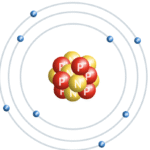
– An atom consists of protons, neutrons, and electrons
– Volume occupied by the nucleus is small, but the atomic mass is concentrated at the nucleus
– most of the volume is occupied by electrons, though they make up a negligible percentage of the atomic mass

ProtonsNeutronsElectrons
Electrical charge/ C+1.602 x 10-190-1.602 x 10⁻¹⁹
Mass/kg1.67 x 10-271.67 x 10-279.11 x 10⁻³¹
Locationnucleusnucleuselectron cloud

Behaviour of Subatomic Particles in an Electric Field
– When a beam containing protons, neutrons, and electrons passes through an electric field, each subatomic particle behaves according to its charge and mass.

– Neutrons have no charge, hence will not be attracted or repelled in an electric field; they will travel in a straight line.
– Protons are positively charged and will be attracted to the negative plate.
– Electrons are negatively charged and will be attracted to the positive plate.

The angle of deflection depends on the relative masses and charges of the particle.

angle of deflection = charge/mass (Q/m)

Since both protons and electrons have the same magnitude charges, and protons are heavier than electrons, angle of deflection of protons are smaller than that of electrons.

Nuclide Representation
– An atom can be represented as AZX;
(Z=proton number; A=nucleon number;X=element symbol)
– proton number = number of protons = number of electrons (for a neutral atom)
– nucleon number = number of protons + number of neutrons

Isotopes
– Isotopes are atoms of the same element but different number of neutrons
– They have the same number of valence electrons, giving them similar chemical properties (eg: reactivity)
– They have different masses, giving them different physical properties (eg: density, boiling point)

ELECTRONIC STRUCTURE

describe the number and relative energies of the s, p and d orbitals for the principal quantum numbers 1, 2 and 3 and also the 4s and 4p orbitals
describe the shapes of s, p and d orbitals (knowledge of wave functions is not required)
state the electronic configuration of atoms and ions given the proton number (and charge)

Scroll to Top