SUBATOMIC PARTICLES
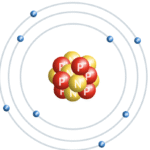
– An atom consists of protons, neutrons, and electrons
– Volume occupied by the nucleus is small, but the atomic mass is concentrated at the nucleus
– most of the volume is occupied by electrons, though they make up a negligible percentage of the atomic mass
| Protons | Neutrons | Electrons | |
| Electrical charge/ C | +1.602 x 10⁻¹⁹ | 0 | -1.602 x 10⁻¹⁹ |
| Mass/kg | 1.67 x 10⁻²⁷ | 1.67 x 10⁻²⁷ | 9.11 x 10⁻³¹ |
| Location | nucleus | nucleus | electron cloud |
Behaviour of Subatomic Particles in an Electric Field
– When a beam containing protons, neutrons, and electrons passes through an electric field, each subatomic particle behaves according to its charge and mass.
– Neutrons have no charge, hence will not be attracted or repelled in an electric field; they will travel in a straight line.
– Protons are positively charged and will be attracted to the negative plate.
– Electrons are negatively charged and will be attracted to the positive plate.
The angle of deflection depends on the relative masses and charges of the particle.
angle of deflection = charge/mass (Q/m)
Since both protons and electrons have the same magnitude charges, and protons are heavier than electrons, angle of deflection of protons are smaller than that of electrons.
Nuclide Representation
– An atom can be represented as AZX;
(Z=proton number; A=nucleon number;X=element symbol)
– proton number = number of protons = number of electrons (for a neutral atom)
– nucleon number = number of protons + number of neutrons
Isotopes
– Isotopes are atoms of the same element but different number of neutrons
– They have the same number of valence electrons, giving them similar chemical properties (eg: reactivity)
– They have different masses, giving them different physical properties (eg: density, boiling point)